What Is WHMIS? A Beginner’s Guide for Ontario Workers
Whether you are patrolling a commercial facility, managing building access, or working alongside maintenance crews, chemical safety is a critical part of everyday workplace awareness in Ontario.
Those bold red-diamond warning symbols you see on cleaning agents, industrial sprays, and storage drums belong to WHMIS, the Workplace Hazardous Materials Information System.
Under the Occupational Health and Safety Act (OHSA), understanding how this system works is not just a recommendation; it is legally required training designed to protect frontline personnel from hazardous substances on the job. Here is what you need to know about WHMIS.
1. The Core Framework and Pillars of WHMIS
WHMIS is Canada’s hazard communication standard, aligned with the Globally Harmonized System (GHS) to ensure chemical danger symbols and classifications match international standards.
The system is built around three core pillars: clear hazard labels on all containers, detailed Safety Data Sheets (SDSs) stored on-site or digitally, and mandatory worker education. Together, these elements give workers the legal right to know exactly what risks exist in their environment and how to handle them safely.
2. Mastering Supplier and Workplace Labels
Reading labels correctly is your first line of defence before opening or moving any substance. Manufacturer containers come with comprehensive supplier labels featuring pictograms, warning statements, and signal words like "Danger" or "Warning."
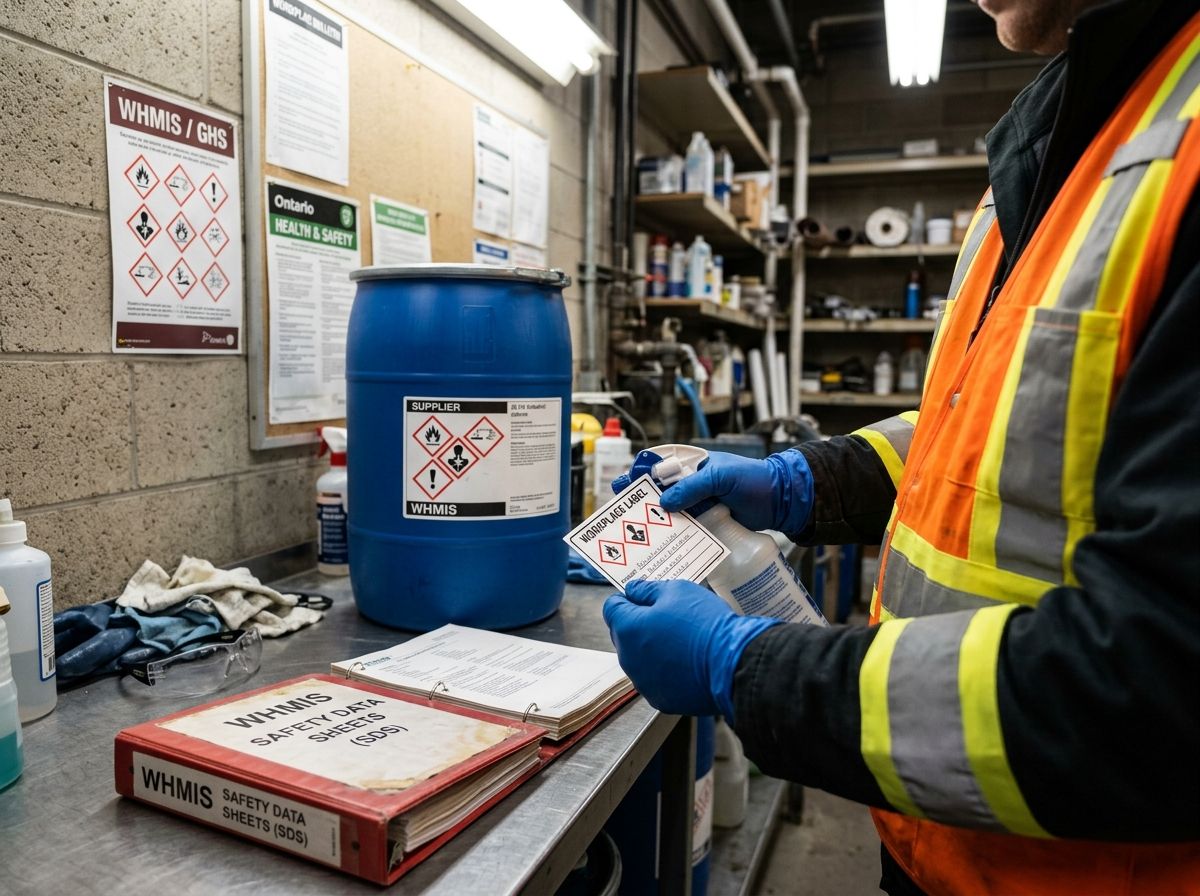
Whenever chemicals are decanted into secondary containers, such as pouring concentrated sanitizer into an everyday spray bottle, a workplace label must be applied immediately showing the exact product name, safe handling instructions, and a reference to the SDS.
3. Navigating Safety Data Sheets (SDSs)
Safety Data Sheets serve as the complete operational manual for any chemical on the property. Every SDS follows a standardized 16-section format, with Sections 4 and 8 being the most critical during daily shifts and incidents because they outline immediate first-aid steps and mandatory personal protective equipment (PPE).
Knowing where these sheets are stored, whether in a physical binder or an online database, ensures you can access vital emergency directions within seconds during a spill or medical crisis.
4. The 4 Essential Safety Questions for Compliance
Every frontline worker in Ontario must be ready to answer four fundamental safety questions: what the hazards are, how to protect yourself, what to do in an emergency, and where to find the product's SDS. Proper certification in WHMIS, paired with hands-on First Aid and CPR readiness, turns routine compliance into genuine emergency preparedness.
Taking the time to understand these standards protects your team, prevents catastrophic workplace incidents, and ensures everyone returns home safely at the end of each shift.